Plagiarism Checker

Submitting a thesis, publishing an article, or reviewing student work? PlagiarismCheckerPlus scans your text against billions of web pages, journals, and academic sources in real time — then delivers a sentence-by-sentence similarity report, not a vague percentage.

Billions of sources
AI detection
Grammar check
Exclude sources
0 / 500 words·0 chars
Your text is never stored or trained on·.docx · .pdf · .txt

Deep crawl scanning technology

Our crawler digs deep through billions of web pages, journals, and academic archives — including cached and obscure sources other checkers quietly skip.

Best-in-market accuracy

Multiple detection engines work together for sentence-level precision and an industry-low false-positive rate — the most accurate similarity report you can get.

Safe & private

Your text is never stored, shared, or used to train AI. Every scan runs privately and is discarded the moment it finishes.

Everything You Need to Catch Every Match

Find, understand, and fix similarity in one place. Click a feature to explore it — or let them cycle.

Deep scanning across billions of sources

12.4B sources

Most checkers index a few hundred million pages. Ours checks against billions — web pages, journals, news, plus cached, obscure, and international content.

Billions of pagesAcademic databasesCached & obscure sources
Plus everything a serious workflow needs

Exclude multiple sources

Whitelist specific URLs or previously uploaded documents so they are excluded from the analysis — eliminating false positives.

Bulk file upload

Upload many files at once and receive individual reports for each. Batch processing is available on professional and institutional plans.

Folder system

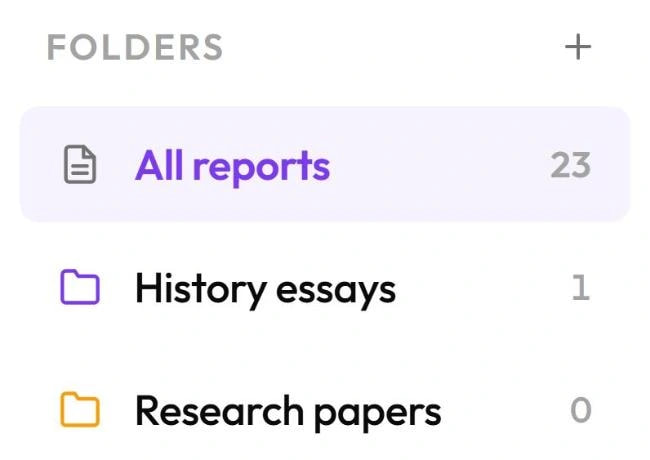
Organize documents into projects, courses, subjects, or client folders so your work stays structured and accessible.

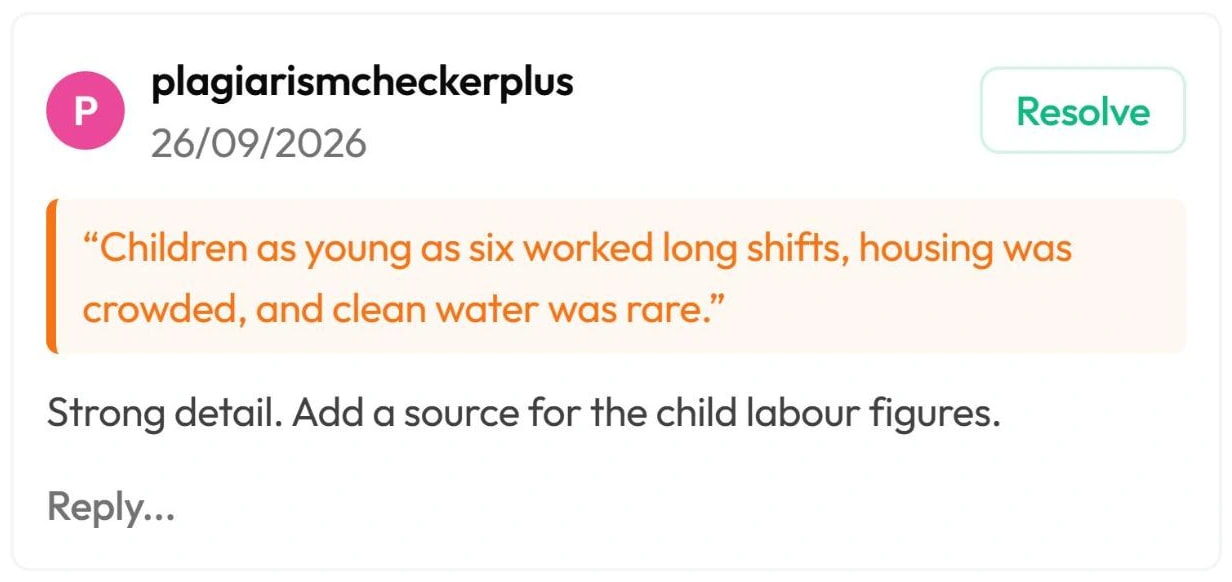
Annotation system

Add comments and notes directly onto flagged sections — ideal for teachers giving feedback or editors reviewing drafts.

Download, save & share

Export any report as a PDF, save it to your account history, or share it via a secure link — date and source data intact.

Admin controls for teams

Control user access, monitor usage, set permissions, and review reports from a single admin dashboard.

Inside Your Similarity Report

plagiarismcheckerplus.com/reports/essay-draft-3
76
/100
Originality
Review 4 passages
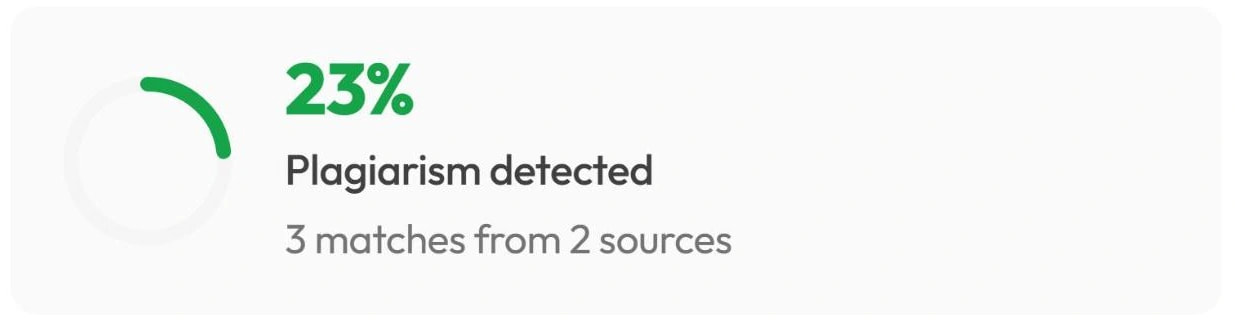
24% matched · 18% uncited · 6% cited
Document
The Industrial Revolution — Final Draft.docx
4,218
Words
4
Sources
8%
AI signal
Page 1 of 14 · Introduction

The Industrial Revolution fundamentally transformed European society between 1760 and 1840, ushering in unprecedented economic growth. Recent studies suggest that the rapid mechanization of textile production was the catalyst for broader social upheaval.

Workers migrated en masse from rural villages to urban centers, where they encountered conditions both promising and perilous. Family structures, class relations, and the rhythm of daily life were all reshaped within a single generation.

Verbatim match · 11 words
britannica.com — no citation found in this paragraph
4 sources matched
britannica.com
Industrial Revolution | Definition, History, Dates, Summary, & Facts
47 words
11%
jstor.orgCited
Mokyr, J. (1998). The Second Industrial Revolution, 1870–1914
23 words
6%
wikipedia.org
History of the textile industry — Mechanization era
18 words
5%
history.comCited
Industrial Revolution: Working Conditions and Labor Reform
9 words
2%
Match composition
Verbatim 11% Paraphrase 6% Original 76%

Originality score at a glance

A single percentage tells you how much of your text matched a source, color-coded so you know in one second whether you are good to publish.

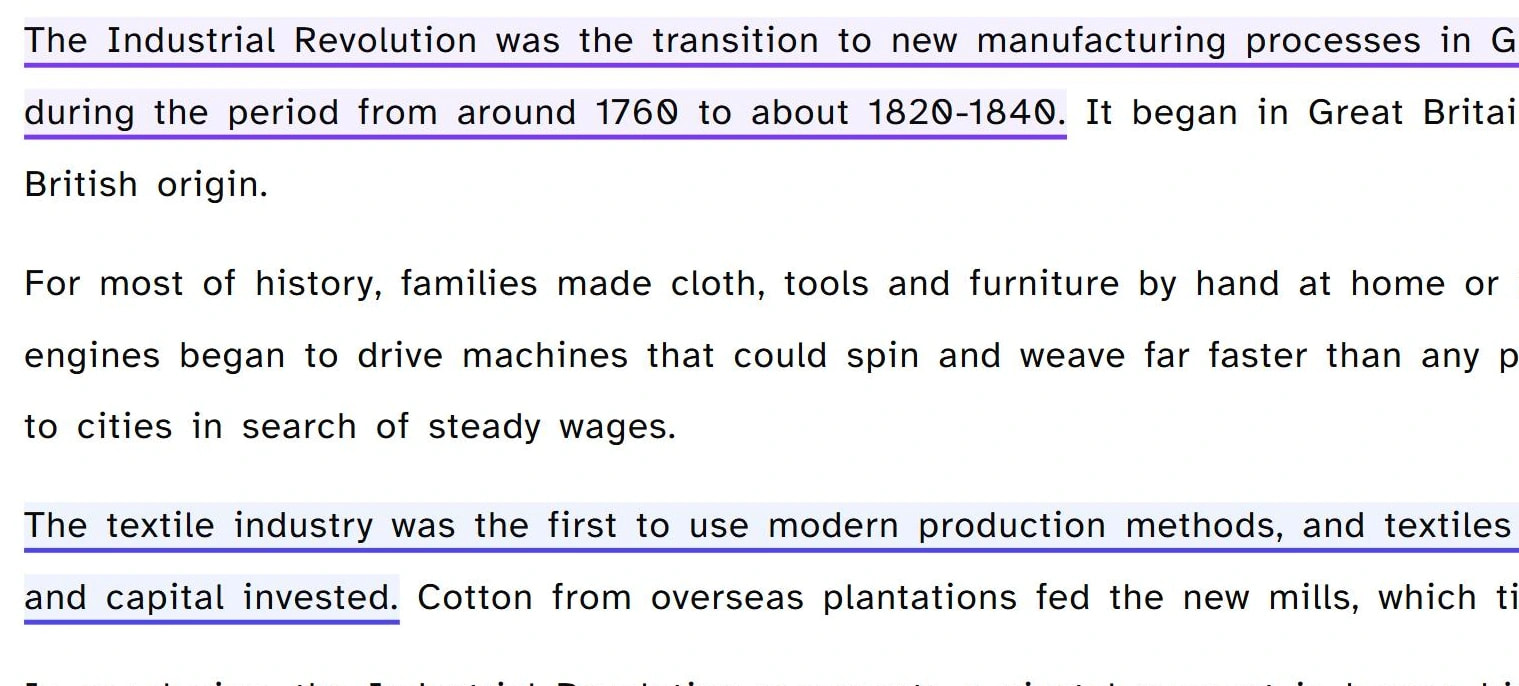
Sentence-level highlights

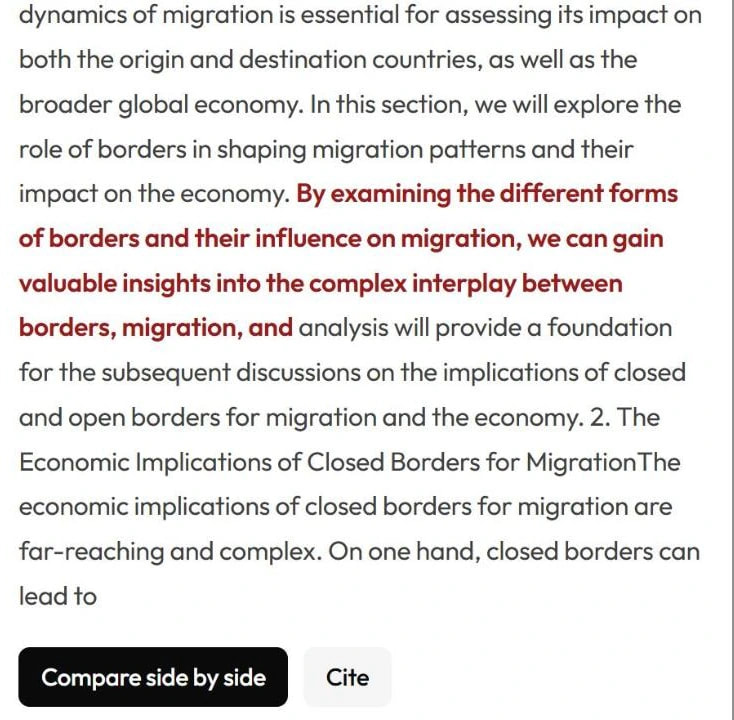
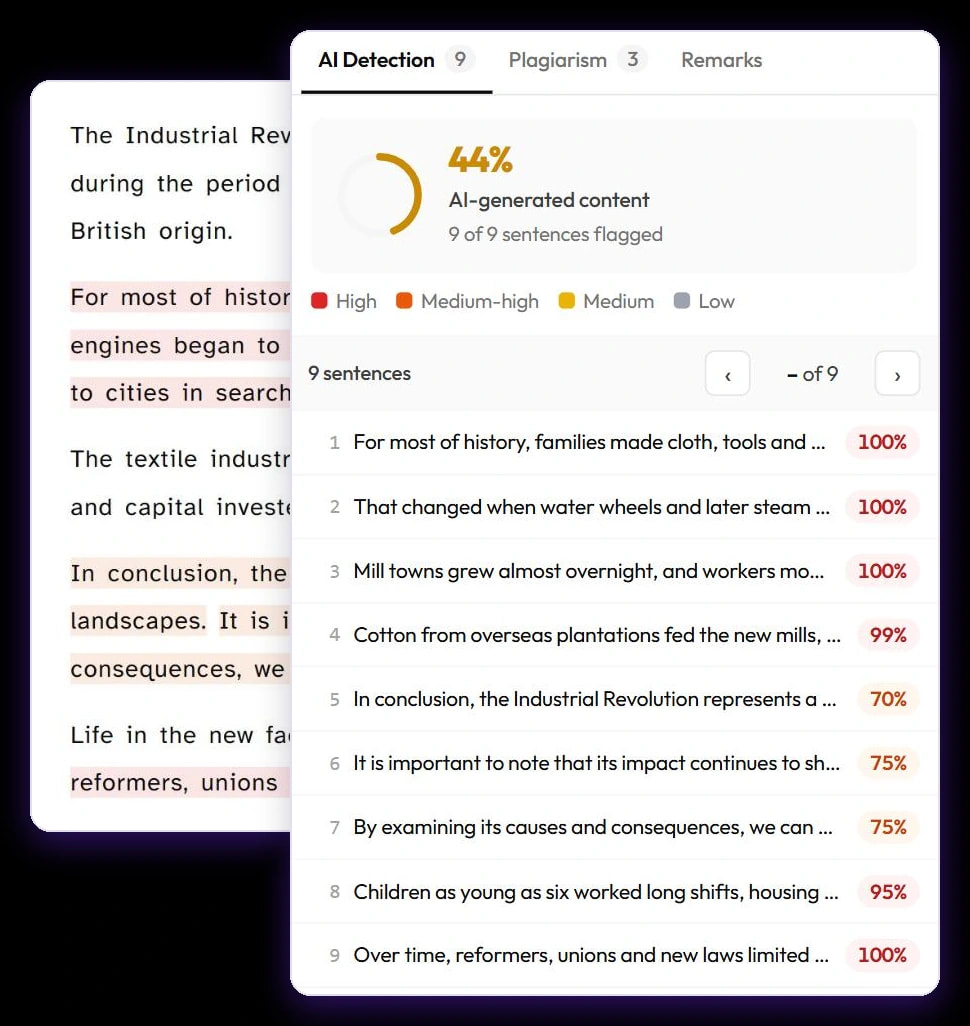
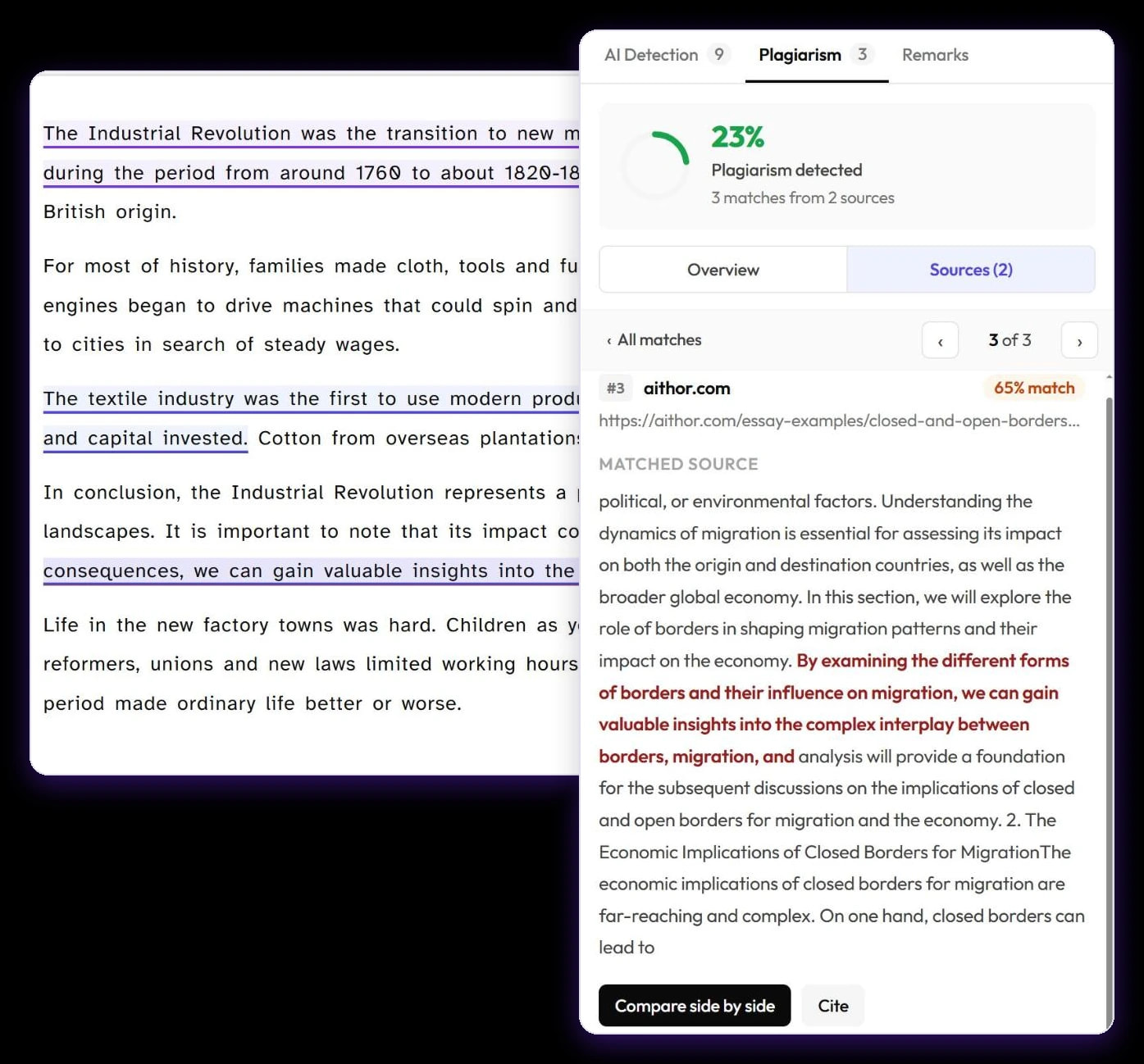
Every flagged sentence is color-coded by match type: exact, paraphrased, or AI-generated. Click any sentence to see the source it matched.

Linked source list

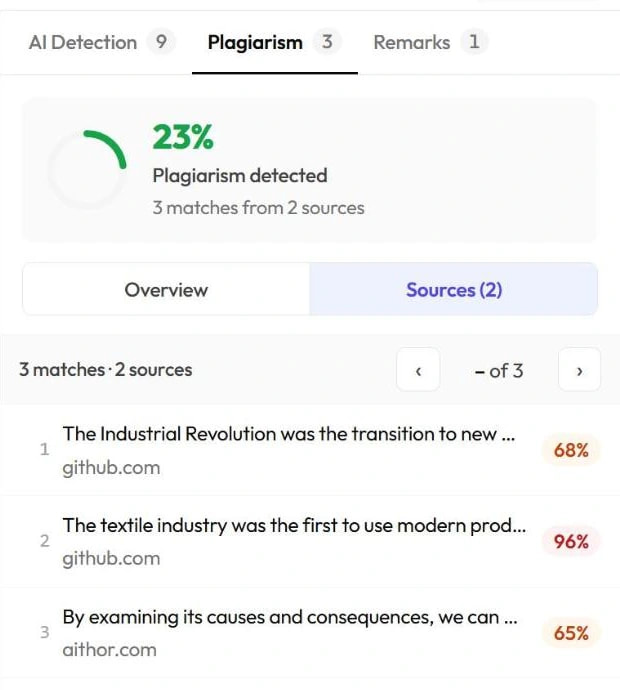
A ranked list of every source we found, sorted by how much of your text matched it. Each source links out so you can verify the match yourself.

Built-in editor for quick fixes

Edit your text in the same window, then click Rescan. No copy-pasting between tools, no losing your place.

Downloadable PDF report

Export a clean report to share with a professor, editor, or client. Use it as proof of originality when it matters.

Institution-Grade Detection

Large institutions have needs that go well beyond individual document checking. Our institutional tier is built for scale, compliance, and deep integration.

Check against your internal database

Upload your own proprietary library — past theses, internal reports, employee handbooks — and use it as a reference for every check. A paper that mirrors last year’s thesis is caught, even if that thesis was never published online.

LMS & platform integration

Connect to Moodle, Canvas, Blackboard, or any custom LMS via our API. Submissions are scanned at the point of upload, with reports delivered to instructors automatically.

Admin dashboard

Manage multiple users, review aggregate usage, set scanning policies, and export reports at scale from a single control panel. No technical expertise required.

Enterprise-grade data privacy

Documents are never stored beyond the session, never shared, and never used for training. For institutions with FERPA, GDPR, or similar requirements, this matters.

Bulk processing at scale

Whether you process 500 end-of-semester submissions or run a quarterly content audit, the system handles high volumes without degrading in speed or accuracy.

Department-level oversight

Coordinators and department heads control access, monitor usage, and review reports across courses and teams — without managing individual accounts by hand.

Why Accurate Plagiarism Detection Actually Matters

Submitting plagiarized work — even accidentally — carries serious consequences. Students face academic penalties, professionals lose credibility, and publishers face copyright disputes. The damage usually goes far beyond the document itself.

Plagiarism is not always obvious

It happens when you forget to cite a source you genuinely read, paraphrase too closely without realizing it, reuse sections of your own previous writing (self-plagiarism), or quote a passage without proper attribution. A good checker shows you exactly where the similarity occurs and what the original source is.

AI-generated text needs a different kind of check

A standard plagiarism check will not catch text written by ChatGPT, Claude, or Gemini— that text is technically “original” because it was never published anywhere. Our built-in AI Detector runs alongside the plagiarism scan, so you see both signals in one report.

A failed citation can cost you a grade, a client, or your byline

Universities fail students for unintentional plagiarism, and Google penalizes sites for duplicate content. A 60-second check upfront is a lot cheaper than any of those.
Unchecked draft
matched
matched
Similarity detected24%
What it can cost you
Academic penalties
Lost credibility & clients
Search-ranking penalties

Access PlagiarismCheckerPlus Your Way

No installation, no plugin, no technical setup. Use the checker wherever you already work.

Web platform

Use the full checker directly in your browser, with no installation and no setup. Works on any device, on any operating system.

Chrome extension

Check text as you write or browse. Highlight any passage on any webpage or document editor and run an instant check without leaving your workflow.

API access

Build plagiarism detection into your own platform, LMS, or internal tool. Developer-friendly, well-documented, and built for scale — ideal for EdTech, publishers, and enterprise teams.

One Tool, Built for Every Kind of Writer

Students, educators, professionals, and institutions all rely on PlagiarismCheckerPlus — for different reasons, in the same workspace.

For students

Submit with confidence

You have spent weeks on your paper. The last thing you want is to fail not because of bad work, but because of a citation oversight. PlagiarismCheckerPlus shows you exactly what to rephrase or cite before you submit — so you learn from the process, not just pass through it. Purpose-built guidance for students lives on our student plagiarism checker.
Final-year dissertations and theses
Research papers and journal submissions
College essays and personal statements
Assignment drafts before final submission
Verify originality of essays and assignments
Provide evidence-based integrity feedback
Run batch checks at the end of each semester
Keep a searchable submission history per course
For teachers & educators

Review smarter, not harder

Grading 40 papers in a weekend is hard enough. Bulk-upload an entire class submission in one go, get a stored report for each, and add comments directly to flagged sections — making feedback transparent for students.
A plagiarism report is one input among several when reviewing student work — see our detection methodology.
For professionals

Protect your reputation

For writers, journalists, legal teams, and communications professionals, originality is a professional and legal concern. Check a draft before it goes to a client, verify a contractor's submission, or scan any document before it becomes official — all inside your existing workflow.
Agencies verifying freelancer submissions
Journalists checking quotes before publication
Legal & compliance document review
Comms teams auditing website content
The stakes

Originality isn’t a nice-to-have. It’s your grade, your byline, your reputation.

One missed citation can undo months of work. A 60-second check before you submit or publish is the cheapest insurance you will ever buy.

Run a free check now

Built on the Latest Detection Technology

Plagiarism detection has come a long way from simple text matching. Our engine combines multiple methods for a low false-positive rate and a high true-positive rate. Read the full technology overview.

Your document
DOCX · PDF · text
Exact
Near-dup
Cross-lang
AI
Originality report
Score · sources · AI

Exact-match detection

Catches word-for-word copying with no exceptions — the most obvious type, and still the most common.

Near-duplicate detection

Identifies close paraphrasing, synonym substitution, and sentence restructuring that dodge basic checkers.

Cross-language matching

Compares content across different languages to detect translated plagiarism presented as original work.

AI-generated content flagging

Identifies passages likely produced by AI writing tools, available alongside the plagiarism check through our integrated AI Detector.

What Is Plagiarism? The Five Types

Plagiarism is presenting someone else’s work — or ideas — as your own without proper attribution. In practice, the line is less clear than most people realize. See also Purdue OWL’s guide.

Type 01

Direct plagiarism

Copying text word for word without quotation marks or attribution. The most straightforward form, and the easiest to detect.

Type 02

Paraphrasing plagiarism

Rewording someone else’s ideas while keeping the same structure and meaning, without acknowledging the source. Far more common than direct copying.

Type 03

Self-plagiarism

Reusing substantial portions of your own previously published or submitted work without disclosure — a problem in academic and publishing contexts alike.

Type 04

Mosaic plagiarism

Also called patchwriting: mixing copied phrases from one or more sources into your own text. Even with an original structure, the borrowed language creates a problem.

Type 05

Accidental plagiarism

Forgetting to cite a source you genuinely used, or misattributing a quote. Intent does not change the result from the perspective of most institutions.

Whatever the type, our checker identifies the matched source so you can make an informed decision — cite, rephrase, or remove.

Scan your text now

How to Avoid Plagiarism (That Actually Work)

Avoiding plagiarism is not complicated, but it requires consistent habits throughout the writing process — not just a last-minute check.

1

Take source notes carefully

Note not just what you find but where you found it — URL, author, publication date, page number. Losing track of a source is one of the most common causes of accidental plagiarism.

2

Paraphrase properly

Changing a few words is not paraphrasing — it is a liability. True paraphrasing means understanding an idea well enough to explain it entirely in your own words, with the source cited.

3

Use quotation marks for direct language

Any time you use a source’s exact words, even a single phrase, put them in quotation marks and cite the original.

4

Cite everything you didn't already know

When in doubt, cite. An unnecessary citation is never a problem; a missing one can be. Our citation generator makes it fast.

5

Run a plagiarism check before you submit

This is the step that catches everything else. Even careful writers miss things — a plagiarism checker is a standard quality check, not a last resort.

Do all five consistently and the final check becomes a formality rather than a scramble.

Check your writing free

Frequently Asked Questions

Yes. You can run your first check without creating an account, including a full similarity scan with sentence-level highlighting. Paid plans unlock bulk upload, folder management, API access, and institutional database checking. See pricing for the full breakdown.

Start Checking Now

Built for students who want to submit confidently, educators who assess work fairly, professionals who protect their reputation, and institutions that take integrity seriously. Accurate. Fast. Private.

No account needed to run your first check.